


Reston’s future: 'New Town' to a new town?

First in a multi-part series on how Reston’s “Live, Work, Play” original vision is evolving as the town moves toward the 2030s and beyond.
By Gene Powell, staff writer
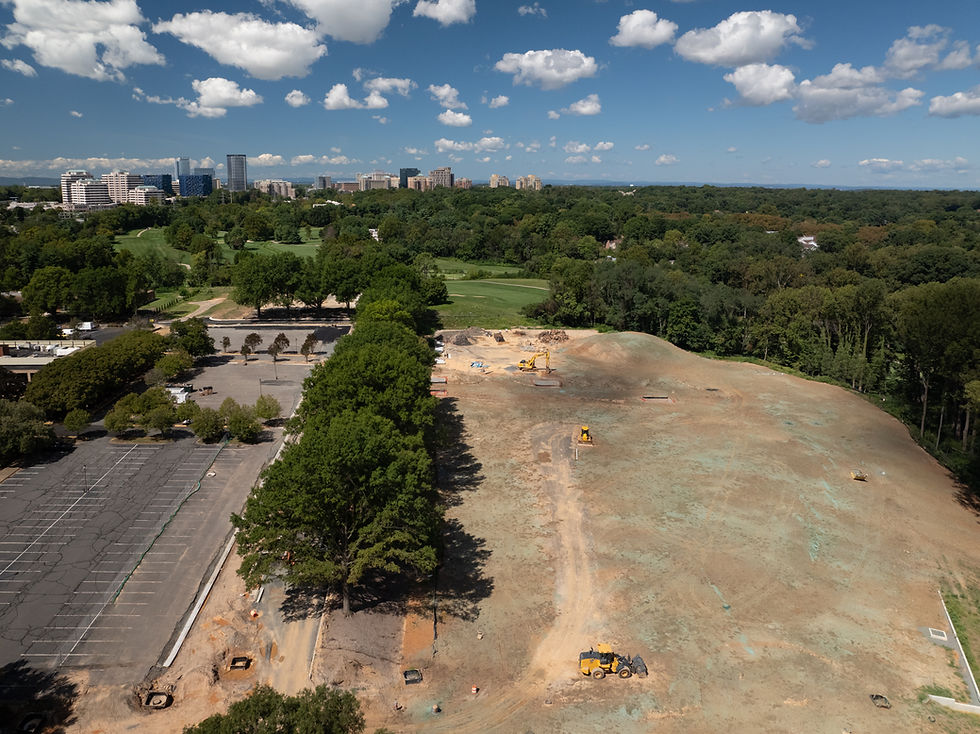
Reston—once again in its 62-year history—is at an inflection point. Major decisions are being made today on housing and commercial redevelopment, from housing density and the repurposing of commercial buildings into townhouse development to the future of one, if not
both, signature golf courses. Metro’s Silver Line Phase 1 reached Reston in 2014, and Phase 2 added two more Reston stops, Herndon and Ashburn stops, and reached Dulles in 2022.
A 1964 article in The New York Times is reported to have praised newly founded Reston as “one of the most striking communities in the United States,” noting a commitment to innovative design and diversity. Founder and developer Robert E. Simon said at the time he envisioned it as a place where people of all races and backgrounds could live in harmony.
Success came quickly to New Town. The first family moved into Reston in 1964, and all of the existing commercial spaces were leased by February 1965, according to the town’s history as reported by the Reston Museum. Simon was inspired by what had been named the “Garden City” urban design movement, with its emphasis on walkable neighborhoods within an urban area, green spaces and mixed-use residential, commercial and light industrial development.
Simon prioritized residential amenities—pools, tennis courts and pedestrian pathways—intertwined with housing “Clusters” and commercial “Village Centers.” Simon also saw the need for a “Town Center,” a relatively dense urban core with commercial outlets, restaurants, a plaza and park as prime features to draw the entire community together. In many ways, Reston holds true to Simon’s vision of a vibrant, egalitarian, highly educated and socially conscious urban homestead—albeit in 2026 with a touch of outsized prosperity, soaring residential values and an aging population.
• A diverse population: The 2024 U.S. Census identified the town’s 65,052 residents (up from 63,226 in 2020 and 58,404 in 2010) as 51% White, 16% Hispanic/Latino, 10% Asian and 7% Black, with 15.4% identifying themselves as “two or more races.” The report also noted Reston’s “foreign-born population” stood at 23.4%.
• A median household income of $154,151, about 1.3 times higher than the DMV area surrounding Washington, D.C.
• 96.1% of Reston’s adults held a high school degree or higher.
• A poverty rate of 7.9%, less than the DMV’s 8.3%, Virginia’s 8.3% and the nation’s 12.2%.
• An attractive mix of community, business and technology, creating what some call the “Silicon Valley of the East,” now home to offices of Microsoft, Leidos, Oracle, Verisign, Google, Amazon Web Services, SAIC, CACI International and others.
But can the “green” community marked by tree-lined residential streets that see a mix of single-family, townhouse and multifamily dwellings retain its identity with newer housing projects focused on townhomes, low-rise “stacked townhomes” or high-rise condo or apart-
ment buildings?
The most visible sites among new housing options: Skymark Reston Town Center, a 40-story apartment building that is the highest mixed-use structure in the D.C. area, and the J.W. Marriott at Reston Station, a 28-story building with 240 hotel rooms and 48 condominiums - one of which sold this summer for nearly $11 million. Both opened in 2025 and faced criticism from some who said they were not compatible with Reston’s original residential designs.
The most-visible conflict: A long-running battle over the future of Reston National Golf Course. Will it remain one of the town’s major green spaces, or will it become a site for new housing? On one side are what a county planner called “the pioneers,” who fear the loss of what brought them and others to Reston decades ago. On the other is a developer who sees an underused, if valuable, community asset as a prime candidate for new housing in a booming urban area.
A recent county-sponsored preview aimed to spark community comment on redevelopment from commercial buildings to residential use of an 112-acre area called “Reston East,” between the Dulles Toll Road and Sunrise Valley Drive. County planners and developers
displayed charts and drawings of what might happen to the area’s rapidly aging commercial buildings.
But the Restonians attending the session were largely focused on how changes would impact their property and lives, from increased traffic to demands on schools and recreational areas. One couple, who said they were longtime homeowners, asked aloud if this “will look like
Reston?”
Next: As residential projects and long-planned ex- pansions such as Reston Town Center North unfold, can Reston sustain Simon’s dream?


Comments