


Reston dojo bows out: United States Karate Center closes after 43 years

by Ellyn Wexler, staff writer
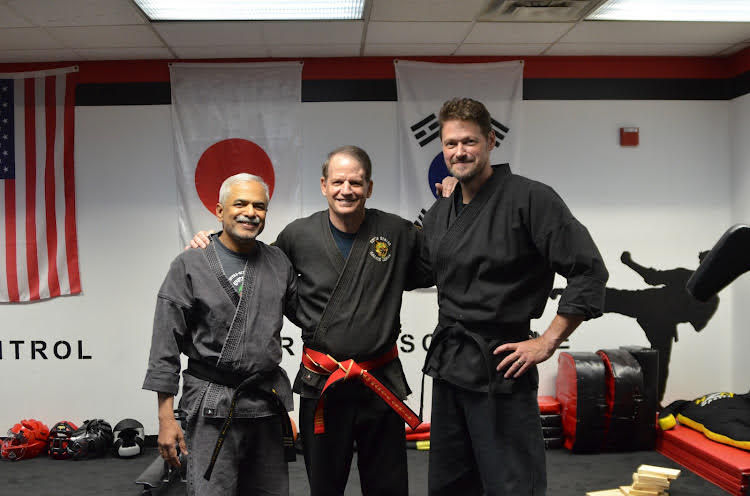
A pillar of the Reston martial arts community has stepped off the mat for the final time.
The United States Karate Center, a longtime institution tucked away in Isaac Newton Square that trained thousands of area children and adults since 1983, closed at the end of May after 43 years in business. Mounting financial and scheduling challenges ultimately forced the decision.
Master John K. Thomas, a former U.S. national full-contact champion, founded the dojo. Two years ago, leadership passed to longtime students Sensei Murali Mooliyil and Sensei Nathan Keysor, a retired Fairfax County master police officer who grew up in Reston and attended South Lakes High School.
Keysor first walked into the dojo at age 13 in 1987, an experience that shaped the course of his life. “Master John K. Thomas’s teaching style immediately resonated with me, and martial arts became a central part of my life from that moment on,” he recalled.
After earning his black belt in 1994, Keysor began teaching, motivated by the lessons martial arts had given him. “I was inspired by the profound impact martial arts had on my own life, giving me discipline, confidence and a sense of purpose,” he said. “I wanted to pass those same benefits on to others, especially children and young adults.”
The closure marks the end of a dojo that emphasized character development over rapid belt advancement. While many martial arts schools operate on a high-turnover “belt factory” model, the center focused on individualized progress.
That philosophy led local parent Nina Li to enroll her daughter, Katie Tung, in the program 18 months ago. “When we were looking at martial arts programs, one thing I wanted to avoid was places that focus purely on advancing through belts as quickly as possible,” Li said. “The United States Karate Center was completely personalized. My daughter competed with herself, not against other kids. The senseis never rushed anyone through.”
Li described the atmosphere as relaxed and welcoming. “The senseis chatted with the kids and the parents about their lives,” she said. “There was a board on the wall celebrating monthly birthdays. It was a small thing, but it showed they valued the kids as individuals.”
The school also emphasized realistic self-defense training, introducing sparring early to help students build confidence. “She became much more confident,” Li noted of her daughter. “The senseis wanted kids to become comfortable with someone directly in front of them. That’s a much more realistic self-defense scenario.”
Parent Alvaro Soto Jr., whose daughter Mya trained at the dojo for more than two years, said the school became a second home for many families. Beyond martial arts instruction, he watched his daughter develop confidence, resilience and self-discipline that carried into other areas of her life. Like many families, Soto believes Reston is losing more than a martial arts school. He sees the closure as the loss of a community where children formed friendships, learned leadership skills and grew into more confident versions of themselves.
Keysor said his 20 years in law enforcement heavily influenced his teaching philosophy. “My background reinforced the importance of real-world self-defense, situational awareness and mental toughness,” he explained. “Martial arts is not just physical. It’s about developing character, integrity and the ability to protect oneself and others.”
For Keysor, the most important lessons were not physical. “Control, honor and discipline,” he reflected. “True martial arts training should make someone a better person, not just a better fighter.”
Taking over the dojo two years ago was both “humbling and challenging” for Keysor. “I never expected to step into Master Thomas’s shoes, but I felt a strong responsibility to preserve the school’s legacy while adapting to new realities,” he said.
Keysor was recently named a 2026 inductee into the Cleveland Martial Arts Hall of Fame and recognized as a Level 7 Instructor by the Police Tactics Instructors of America.
Ultimately, rising operational costs in Northern Virginia and Keysor’s relocation to West Virginia made it impossible to continue. “It was a tough but necessary decision,” he acknowledged.
For Keysor, the most meaningful part of the school’s legacy was watching students grow over the decades.
“There are so many memories: watching shy children become confident leaders, seeing students overcome physical challenges and celebrating black belt achievements,” he said. “Many former students still reach out years later to tell me how USKC positively shaped their lives.”
Despite the closure, Keysor hopes the school will be remembered for more than martial arts instruction alone. “I would like the school to be remembered as a place where students learned not just techniques, but values, respect, discipline and personal growth under the guidance of Master Thomas’s authentic teachings,” he said.
Families and alumni wishing to share memories or stay connected with former dojo members can still reach the organization through its longtime email address at uskc.online@gmail.com.


Comments