


Reston resident Bill Brazier hopes to revive civic discourse

By Lincoln Patience, Staff Writer
Civic participation has always been central to Bill Brazier’s life. The son of a political science professor in Boston, Brazier grew up steeped in conversations about government, public service, and civic duty. As a young adult, he worked behind the scenes of Massachusetts politics—keeping company payment records current with the Secretary of State’s office, calling voters, and helping organize party caucuses and conventions when his boss ran for re-election. “That was both fulfilling and frustrating in so many ways,” Brazier said.
Brazier went on to earn a degree in Soviet Studies at Columbia University before moving to Arlington, where he worked as an analyst for the Committee on U.S.-Soviet Relations during the final, turbulent years of the Soviet Union. While energized by the democratic changes unfolding in Russia, he ultimately decided to change course. “I thought it would be difficult to have a family and work for the Foreign Service,” he said.
By 1993, he and his wife had welcomed the first of their two children and had settled in Reston, drawn by its open spaces and engaged community life. Brazier began teaching at Loudoun County High School before moving to Stone Bridge High School, where he later chaired the social science department. Over nine years in the classroom, he found particular joy in teaching electives. “I considered myself very lucky because I got to teach the electives,” Brazier said. “They gave me the chance to explain a lot of ideas that I hadn’t really explored before.”
Philosophy was one of those areas. Brazier returned to school at George Mason University, earning a master’s degree and deepening his engagement with the discipline. “I think the questions philosophy raises are foundational to us as human beings,” he said. “We can’t set up a society for human beings until we have an answer to what human beings are.”
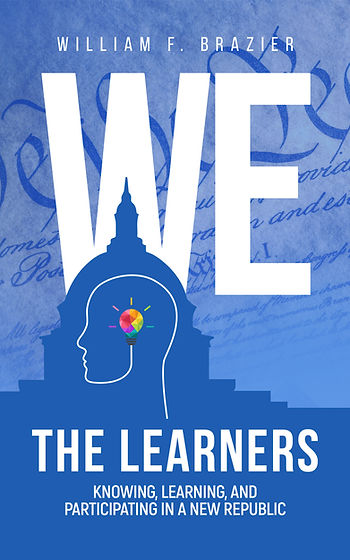
Those ideas form the backbone of his new book, “We, the Learners: Knowing, Learning, and Participating in a New Republic,” which traces the development of Western philosophy through thinkers including Locke, Kant, Berkeley, Nietzsche, and others.
In 2003, Brazier became Supervisor of Social Science and Global Studies for Loudoun County Public Schools, a role he held for 15 years. A 2020 district Facebook post announcing his retirement credited him with helping replace certain Standards of Learning tests with performance assessments, an approach later reflected statewide when Virginia eliminated five SOL tests in 2014. Known for clear communication and a commitment to best practices, Brazier also encouraged students, including his own daughters, to study foreign languages.
Public service runs deep in the Brazier family. His older daughter has done healthcare work in Guatemala. His younger daughter is a family services attorney in Portland, Maine, working with immigrants and refugees, many from French-speaking Africa. His wife spent 40 years as a special education teacher in Washington, D.C.
At the core of Brazier’s worldview is intellectual humility, a principle that guided his work developing equity and inclusion training for the State of Virginia and the U.S. Capitol Police, an area that has grown increasingly politicized. Brazier describes his approach as educational rather than ideological.
“If you have people who are willing to adopt a disposition of intellectual humility, it works better,” he said. “People know their egos aren’t involved. If you have that disposition, you’re going to have more productive humans, more productive work, and more productive outcomes.”
After earning their trust, he would tell police officers, “Nobody has all the answers. We have to find the answers together.”
That search for shared understanding—and for a collective public will—now shapes Brazier’s political thinking. In the concluding chapters of his book, he proposes constitutional modifications inspired by the fictional city in Plato’s “Republic.” While the specifics may spark debate, Brazier said his larger aim is not sweeping reform but renewed civic conversation.
“Learning is the center of who we are,” he said. “When we lose that, or when we have a society that doesn’t promote it, we’re all off-kilter.”
Ultimately, Brazier hopes to move policy, and the discussions that shape it, out of congressional gridlock and presidential fiat, and back into the hands and minds of informed citizens. “I think Reston is the kind of place where that conversation can begin,” he said.


Comments